
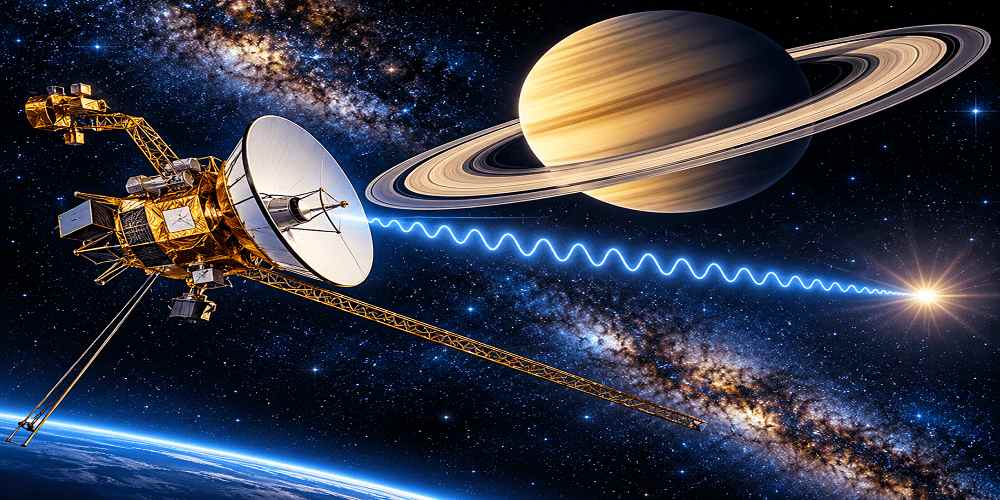
The Voyager 1 data glitch NASA has become an important topic in space exploration after the world's most distant operational spacecraft experienced another technical problem in November 2026. After travelling through space for more than 49 years, Voyager 1 has reached an extraordinary milestone: it is now one light-day away from Earth. However, around the same time, NASA engineers discovered that the spacecraft had stopped transmitting useful scientific and engineering data.
Although NASA can still detect Voyager 1's radio carrier signal, the information that normally accompanies the signal is currently missing. This has created a new challenge for scientists and engineers responsible for keeping the historic spacecraft operational.
The situation is particularly interesting because Voyager 1 is operating billions of kilometres away from Earth using technology developed during the 1970s. Every command sent from Earth takes approximately 24 hours to reach the spacecraft, and its response takes another 24 hours to return.
In this article, we will explore the Voyager 1 data glitch NASA is investigating, what caused the communication problem, how engineers are attempting to resolve it, and what this development means for the future of space exploration.
What Is the Voyager 1 Data Glitch NASA Is Investigating?
NASA's Voyager 1 spacecraft experienced a technical issue on November 14, 2026. The mission team discovered that although the spacecraft was transmitting a radio carrier signal, it was no longer sending usable scientific or engineering information.
NASA's Deep Space Network antenna in Canberra, Australia, successfully detected the spacecraft's signal. However, engineers could not recover the usual data that provides information about its scientific instruments and onboard systems.
According to NASA's November 18 update, the problem appears to involve the onboard computer responsible for collecting information from different spacecraft systems and preparing it for transmission.
This computer is known as the Flight Data Subsystem (FDS).
The FDS plays an important role in Voyager 1's communication process. It gathers measurements from scientific instruments, collects engineering information, and organizes the information into a format that can be transmitted to Earth.
When this process stops working correctly, NASA may still receive a radio signal without receiving the actual information scientists need.
The important point is that NASA has not reported that Voyager 1 has completely stopped functioning. The carrier signal indicates that some important communication systems are still working.
NASA engineers are continuing to investigate the cause of the latest problem and determine the next steps.
Why Did NASA's Voyager 1 Stop Sending Scientific Data?
The latest communication issue is particularly challenging because Voyager 1 has been operating for nearly five decades.
Its onboard computers, electronic components, and communication systems were designed using technology available during the 1970s. Although engineers have successfully maintained the spacecraft for much longer than originally expected, its ageing hardware creates new challenges.
There are several possible explanations for the current problem.
1. Flight Data Subsystem Problem
The Flight Data Subsystem is one of the most important components involved in sending information from Voyager 1 to Earth.
It collects scientific measurements and engineering information before preparing them for transmission.
If the FDS cannot process this information correctly, NASA may receive a carrier signal without usable data.
NASA's November 18 update identified this subsystem as the likely area of concern, although engineers had not confirmed the precise cause.
2. Ageing Computer Hardware
Voyager 1 was launched in 1977, meaning its electronic components have been exposed to the difficult conditions of space for almost 50 years.
Electronic hardware can gradually deteriorate because of ageing, radiation exposure, and long-term operation.
A malfunctioning memory component or another internal electronic problem could affect how the spacecraft processes information.
NASA has previously faced similar challenges with Voyager 1, demonstrating how difficult it can be to maintain technology that has operated for so many decades.
3. Possible Connection With the October Communication Loss
The latest issue followed another unusual event in October 2026.
NASA temporarily lost communication with Voyager 1 on October 18 and 19. The spacecraft's radio signal returned on October 20, and communication was restored.
According to NASA, one group of thrusters had gone offline, causing backup thrusters to activate automatically.
Engineers are investigating whether the October communication interruption has any connection with the November data problem.
However, a direct connection has not yet been established.
How Is NASA Trying to Fix the Voyager 1 Data Glitch?
Fixing a spacecraft problem is difficult even when the spacecraft is close to Earth. The challenge becomes much greater when the spacecraft is more than 25 billion kilometres away.
NASA engineers cannot physically inspect Voyager 1, replace a damaged computer, or connect a diagnostic device directly to its hardware. Instead, they must investigate the problem using radio signals, historical engineering records, and commands transmitted through the Deep Space Network.
The current troubleshooting process involves several important steps.
1. Monitoring the Radio Carrier Signal
The first important step is checking whether Voyager 1 is still transmitting a signal.
A carrier signal is a radio transmission that helps engineers establish communication with the spacecraft. Its presence indicates that the spacecraft's antenna and broadcasting equipment are still operating.
NASA has confirmed that the carrier signal is being received even though scientific and engineering data are missing.
This is an encouraging sign because it suggests that Voyager 1 has not completely lost its ability to communicate with Earth.
2. Investigating the Onboard Computer
NASA engineers are focusing on the Flight Data Subsystem because it handles the information that needs to be transmitted.
They need to understand why the computer is no longer delivering the expected data.
The investigation may involve examining the spacecraft's previous behaviour, reviewing available telemetry information, and sending carefully planned commands.
Since the spacecraft is extremely far away, engineers must wait for each command to reach it before they can receive a response.
3. Using Experience From Previous Technical Problems
NASA has already dealt with similar communication challenges involving Voyager 1.
In 2023 and 2024, the spacecraft experienced a serious computer problem that prevented it from sending readable scientific and engineering information.
Engineers eventually identified corrupted memory inside the Flight Data Subsystem. Approximately 3% of its memory had been affected.
The team suspected that a memory chip had stopped working, possibly because of ageing or exposure to energetic particles in space.
Rather than physically repairing the chip, engineers found a creative solution. They relocated the affected software code to other available memory locations.
This allowed Voyager 1 to resume sending understandable information to Earth.
The previous recovery provides valuable experience for the current investigation, although NASA has not confirmed that the latest problem has the same cause.
NASA Science+1
Why Does It Take Two Days to Communicate With Voyager 1?
One of the most fascinating aspects of the Voyager 1 data glitch NASA is investigating is the enormous distance between the spacecraft and Earth.
Voyager 1 has travelled so far that radio communication has become a slow process.
On November 18, 2026, the spacecraft reached a distance of approximately 16.1 billion miles (25.9 billion kilometres) from Earth.
This distance is equivalent to one light-day.
A light-day represents the distance light travels in 24 hours.
Because radio signals travel at approximately the speed of light, a message sent from Earth takes around 24 hours to reach Voyager 1.
The response then takes another 24 hours to return.
This creates a communication delay of approximately 48 hours for a complete command-and-response cycle.
For example, imagine NASA engineers discover a possible issue with the spacecraft's computer.
They prepare a command and transmit it through the Deep Space Network. The spacecraft receives that command approximately one day later.
After processing the instruction, Voyager 1 sends information back to Earth. Engineers must then wait another day before receiving the response.
Only after that can they analyse the results and decide what to do next.
This makes troubleshooting a complicated and time-consuming process.
A problem that might take a few minutes to investigate on a spacecraft near Earth could require several days or longer when dealing with Voyager 1.
NASA has explained that the distance makes even relatively simple engineering investigations a drawn-out process.
NASA Science+1
Voyager 1 Reaches One Light-Day From Earth in 2026
Despite its latest technical problem, Voyager 1 achieved a historic milestone in November 2026.
On November 18, the spacecraft became the first human-made object to reach a distance of one light-day from Earth.
NASA officially announced the achievement on November 19, 2026.
The milestone represents more than 49 years of continuous travel through space.
Here are some important details about the achievement:
- Spacecraft: Voyager 1
- Launch date: September 5, 1977
- Historic milestone: One light-day from Earth
- Milestone date: November 18, 2026
- Distance: Approximately 25.9 billion kilometres
- Speed: Approximately 61,155 kilometres per hour
- Mission organisation: NASA
The achievement demonstrates how far human technology can travel beyond our planet.
It also highlights the extraordinary work of generations of scientists, engineers, and mission controllers who have kept the spacecraft operational.
Interestingly, the communication issue did not prevent NASA from confirming the milestone.
Scientists used the carrier signal and trajectory calculations to determine the spacecraft's position.
This means that even without receiving normal scientific and engineering data, NASA could still establish that Voyager 1 had crossed the one-light-day distance.
The milestone is particularly significant because Voyager 1 continues travelling farther into interstellar space, where it is studying an environment that no other operational spacecraft has explored so extensively.
NASA+1
What Is the NASA Deep Space Network?
The Deep Space Network (DSN) is an international communication system that NASA uses to communicate with spacecraft exploring distant parts of the solar system and beyond.
It plays a critical role in the Voyager 1 mission.
Without this network, NASA would not be able to receive information from Voyager 1 or send commands to its onboard computers.
The network operates through three major communication facilities located in different parts of the world.
These facilities are:
- Goldstone, California, United States
- Madrid, Spain
- Canberra, Australia
Their geographical positions allow NASA to maintain communication with spacecraft as Earth rotates.
The antennas are designed to receive extremely weak signals travelling across enormous distances.
For Voyager 1, these signals contain important information about the spacecraft's condition and the scientific measurements collected by its instruments.
The Canberra facility played an important role in identifying the November 2026 issue because its antenna successfully detected the spacecraft's carrier signal.
However, detecting a signal and receiving usable scientific information are two different things.
The current problem demonstrates why both the communication equipment and onboard data-processing systems are essential for a successful deep-space mission.
What Scientific Information Does Voyager 1 Normally Send to Earth?
Voyager 1 is not simply travelling through space. It is also collecting scientific information that helps researchers understand the environment beyond the influence of the Sun.
The spacecraft carries instruments designed to study particles, magnetic fields, and other characteristics of interstellar space.
Two of its remaining operating scientific instruments are particularly important.
1. Magnetometer
The magnetometer measures magnetic fields in the surrounding environment.
These measurements help scientists understand the structure and behaviour of magnetic fields beyond the heliosphere.
The information is valuable because the region outside the Sun's protective magnetic bubble is still not fully understood.
2. Plasma Wave Instrument
The plasma wave instrument studies plasma waves and electrical activity in the surrounding space.
Plasma is a state of matter containing electrically charged particles.
By studying these waves, researchers can learn more about the density and behaviour of the plasma surrounding Voyager 1.
Both instruments provide important information about interstellar space.
When Voyager 1 cannot send usable science data, researchers temporarily lose access to these new measurements.
However, the spacecraft's earlier discoveries and previously transmitted scientific information remain valuable.
The mission has already changed our understanding of the outer solar system and the space beyond the heliosphere.
NASA+1
Why Is Voyager 1 Still Important After 49 Years?
Voyager 1 was originally designed to explore the outer planets of our solar system.
NASA launched the spacecraft on September 5, 1977, with the goal of studying Jupiter and Saturn.
At that time, nobody expected the spacecraft to continue operating for almost five decades.
Its mission eventually expanded beyond the original planetary exploration programme.
Voyager 1 completed several important achievements.
Exploration of Jupiter
Voyager 1 reached Jupiter in 1979 and collected detailed information about the giant planet and its moons.
One of its most important discoveries involved volcanic activity on Io, one of Jupiter's largest moons.
The discovery demonstrated that volcanic activity was not limited to Earth.
Exploration of Saturn
Voyager 1 reached Saturn in 1980.
It studied the planet's atmosphere, rings, and moons, providing valuable information that improved scientists' understanding of the Saturnian system.
Entering Interstellar Space
One of Voyager 1's greatest achievements occurred in August 2012.
It became the first human-made spacecraft to enter interstellar space after crossing the heliopause.
The heliopause represents the boundary where the solar wind's influence becomes weaker than the surrounding interstellar environment.
Voyager 2 later crossed this boundary in November 2018.
These achievements explain why NASA continues investing time and resources in keeping the spacecraft operational.
Even today, Voyager 1 provides researchers with direct measurements from an environment that cannot easily be studied using Earth-based instruments.
NASA+1
How Does Voyager 1 Get Electricity After So Many Years?
Another major challenge facing Voyager 1 is its limited power supply.
The spacecraft does not use traditional solar panels because sunlight becomes extremely weak at such enormous distances from the Sun.
Instead, it uses a radioisotope thermoelectric generator (RTG).
This system converts heat produced by the radioactive decay of plutonium into electricity.
The generator has allowed Voyager 1 to continue operating far beyond its original mission timeline.
However, the available electrical power gradually decreases over time.
NASA estimates that the Voyager spacecraft lose approximately four watts of electrical power every year.
As the power supply becomes weaker, engineers must make difficult decisions about which instruments and systems should remain operational.
In September 2026, NASA successfully completed another power-saving effort by switching off three devices and using lower-power alternatives.
The purpose was to conserve electricity and help keep the remaining scientific instruments operating for longer.
These adjustments are important because every watt of electricity matters when maintaining a spacecraft that has been travelling through space since 1977.
NASA expects the latest power-saving work to help the spacecraft continue its scientific operations towards its 50th launch anniversary in 2027.
NASA Science+1
Will NASA Be Able to Fix the Voyager 1 Data Glitch?
The answer depends on what is causing the current problem.
NASA has successfully recovered Voyager 1 from several technical issues in the past, including serious computer and communication problems.
The 2024 recovery is an excellent example of how engineers can develop creative solutions without physically accessing a spacecraft.
However, the latest issue should not automatically be considered identical to the previous one.
The spacecraft is older, its available power is decreasing, and some electronic components have been operating continuously for decades.
NASA engineers must first understand the underlying problem before deciding which commands or software adjustments could help.
The presence of a carrier signal is encouraging because it indicates that Voyager 1 can still communicate at a basic level.
Nevertheless, it does not guarantee that the scientific data transmission will recover.
If engineers identify a software or memory-related issue, they may be able to develop another workaround.
If the problem involves permanently damaged hardware, finding a solution could be more difficult.
As of the latest NASA update available on November 25, 2026, the team is investigating the issue. NASA has not announced a confirmed recovery of normal science and engineering data.
The mission remains an extraordinary example of engineering innovation and long-term scientific exploration.
What Happens If Voyager 1 Stops Working Permanently?
Although NASA is working to keep Voyager 1 operational, the spacecraft cannot continue working forever.
Its power supply is gradually decreasing, and its electronic components are becoming older. Eventually, the spacecraft may no longer have enough electricity to operate its scientific instruments or communicate with Earth.
If Voyager 1 stops sending information permanently, it will continue travelling through interstellar space.
There is no practical way for NASA to send astronauts or a repair spacecraft to its current location.
Even if its communication systems stop working, Voyager 1 will remain an important part of human space exploration.
The spacecraft also carries the famous Golden Record, which contains sounds, music, images, and greetings representing life on Earth.
The record was designed as a message for any intelligent life that might discover the spacecraft in the distant future.
Voyager 1 will continue moving through space for thousands of years, even after its electrical systems stop functioning.
Its journey represents humanity's curiosity about the universe and our desire to explore places beyond our planet.
What Can We Expect From the Voyager 1 Mission in the Future?
NASA's priority is to maintain communication with Voyager 1 for as long as technically possible.
Engineers will continue investigating the current data transmission problem and looking for ways to protect the spacecraft's remaining operational systems.
The mission also highlights the importance of designing spacecraft that can survive unexpected technical challenges.
Future space missions may benefit from the lessons learned through Voyager 1, particularly in computer reliability, power management, communication systems, and remote troubleshooting.
The spacecraft has already exceeded its original mission expectations by decades.
Even if NASA cannot immediately resolve the latest issue, Voyager 1's previous discoveries will continue contributing to scientific research.
For space enthusiasts, the mission remains a reminder that some of humanity's greatest achievements are not always measured by how quickly we reach a destination but by how much we learn along the way.
Conclusion
The Voyager 1 data glitch NASA is investigating represents another major technical challenge for humanity's most distant spacecraft. After travelling for more than 49 years, Voyager 1 has stopped returning normal scientific and engineering data, although its carrier signal remains detectable.
NASA engineers are focusing on the Flight Data Subsystem and investigating whether the latest issue is connected to earlier communication problems.
The spacecraft's recent achievement of reaching one light-day from Earth makes this situation even more remarkable. Every command now requires approximately one day to reach Voyager 1, and another day is needed for its response to return.
Although its future remains uncertain, Voyager 1 has already made extraordinary contributions to space science. Its mission demonstrates the importance of engineering innovation, patience, and scientific curiosity.
As NASA continues investigating the problem, the world will be watching to see whether engineers can restore the spacecraft's valuable scientific data transmission.
Frequently Asked Questions (FAQs)
1. What is the Voyager 1 data glitch NASA reported in November 2026?
NASA reported that Voyager 1 stopped sending usable scientific and engineering data on November 14, 2026. The spacecraft continues transmitting a carrier signal, but its onboard Flight Data Subsystem appears to be experiencing a problem.
2. Is NASA's Voyager 1 still working?
Voyager 1 is still transmitting a radio carrier signal. This indicates that important communication equipment is functioning, although NASA is currently unable to receive normal scientific and engineering data.
3. How far away is Voyager 1 from Earth in 2026?
On November 18, 2026, Voyager 1 reached approximately 25.9 billion kilometres (16.1 billion miles) from Earth. This distance is equivalent to one light-day.
4. Why does communication with Voyager 1 take 48 hours?
Voyager 1 is approximately one light-day away from Earth. A radio signal takes around 24 hours to reach the spacecraft, and its response takes another 24 hours to return.
5. Can NASA repair Voyager 1's computer from Earth?
NASA cannot physically repair the spacecraft because it is extremely far away. However, engineers can transmit commands, modify software instructions, and use alternative memory locations to overcome certain computer problems.
Leave A Comment
0 Comment